
610 Loop Crash? 4 Parties You Can Hold Responsible Beyond the Truck Driver

Executive Summary: 60-Second Insight
Determining liability on Houston’s I-610 Loop requires unmasking a complex chain of responsibility that extends from the driver to freight brokers and manufacturers. Under Texas HB 19, litigating these cases is a two-step process that demands immediate forensic preservation of ELD and black box data. Robert Law Group applies Big Law discovery tactics to ensure victims overcome the 51% bar rule and hold every negligent party accountable.
The 610 Infrastructure Strain: Why Interchanges Lead to Injury
Interstate 610, also known as The Loop, marks the critical boundary between Houston’s inner city and its vast surrounding areas. With nearly 300,000 vehicles traveling this 38-mile stretch daily, the mixing of heavy commercial trucks and daily commuters creates a high-risk environment. Tight curves, short acceleration lanes, and frequent construction on the North Loop and Southwest Freeway junctions frequently lead to catastrophic rear-end and jackknife collisions. When an accident occurs in these bottlenecks, the resulting multi-vehicle pileups often involve complex layers of liability.
The “Loop” of Responsibility: Identifying the Liable Parties
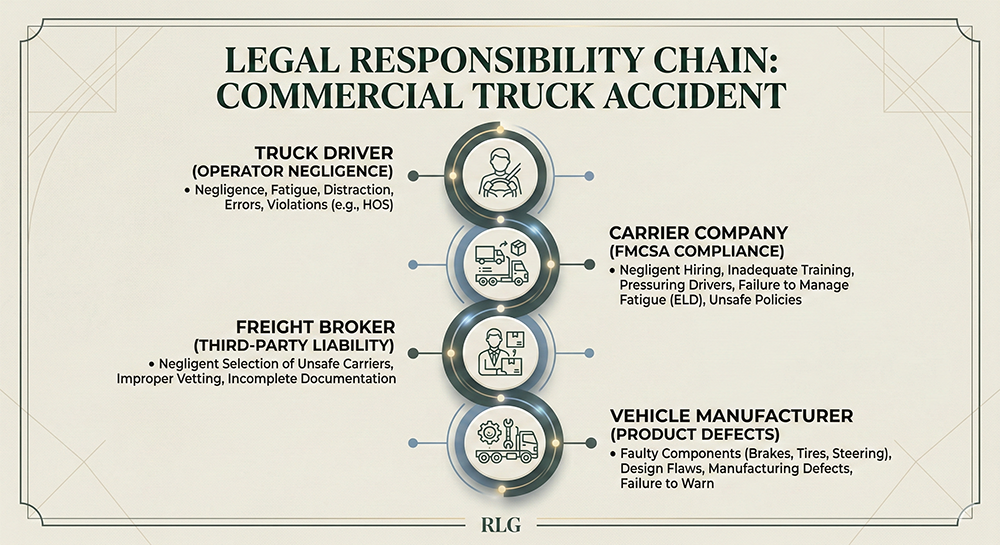
Unlike standard car wrecks, commercial vehicle accidents on the Loop involve a network of corporate entities. Identifying every link in the chain is essential for a full financial recovery:
- The Trucking Company: Employers are often liable for the negligent acts of their drivers under the doctrine of respondeat superior. They also face direct liability for negligent hiring, improper training, or pressuring drivers to ignore rest requirements.
- Freight Brokers and Shippers: Companies that make shipping arrangements can be held accountable for negligently hiring unqualified or unsafe carriers.
- Maintenance and Tech Crews: If a mechanical failure like brake collapse caused the crash, the independent facility responsible for the vehicle’s upkeep may share the blame.
- Cargo Loaders: Improperly balanced or unsecured cargo that shifts during a tight turn on a Loop ramp can make the company that loaded the trailer liable.
Texas law uses a modified comparative negligence system. This means a victim can only recover damages if they are found to be 50% or less responsible for the accident. If a jury assigns you 51% of the fault, you are legally barred from any recovery. This threshold makes the initial investigation and fault assignment a vital legal battleground.
Furthermore, Texas House Bill 19 mandates that trucking trials be split (bifurcated) upon a defendant’s request. The first phase focuses solely on the driver’s negligence and compensatory damages. Only after winning this phase can a claimant proceed to a second phase against the employer for exemplary (punitive) damages. Robert Law Group uses Big Law experience to weave a narrative of corporate failure into the initial phase, ensuring the trucking company’s oversight is never hidden from the jury.
The Forensic Evidence Required for Victory
Establishing liability requires a high burden of proof and immediate action. Critical evidence often resides in the exclusive control of the trucking company and may disappear without a spoliation letter. We relentlessly pursue:
- ELD Data and Driver Logs: These digital records reveal fatigue-inducing hours-of-service violations.
- Black Box Telemetry: Speeding, sudden braking, and reckless acceleration patterns are all captured in the truck’s engine control module.
- Maintenance and Inspection Records: These documents prove whether a company fulfilled its obligation to keep the rig in a safe operating condition.
The RLG Standard: High-Stakes Advocacy
At Robert Law Group, we apply the discipline of an Air Force veteran and the precision of a Big Law litigator to navigate Houston’s most complex freeway accidents. We understand that “Loop 610” accidents are never simple, and we fight to ensure no liable party is overlooked in your pursuit of justice.

Recovery For Personal Injury And
Products Liability Cases Begins Here